
Amidon Briefing · Independent Testing & Standards
UL 752, 12th Edition: A Threat-Specific Standard for Ballistic Protection
Ballistic protection starts with a direct question: what must the barrier stop? UL 752, 12th Edition, gives architects, engineers, range planners and facility owners a precise way to answer that question. The standard defines specific handgun, rifle and shotgun threats, then evaluates how a material, building component or complete assembly performs against the selected threat profile.
For Amidon, that approach aligns with how ballistic infrastructure should be designed. The mission defines the threat. The threat defines the required performance. The wall system, structural configuration and complete training environment are then engineered around that requirement.
What UL 752 Measures
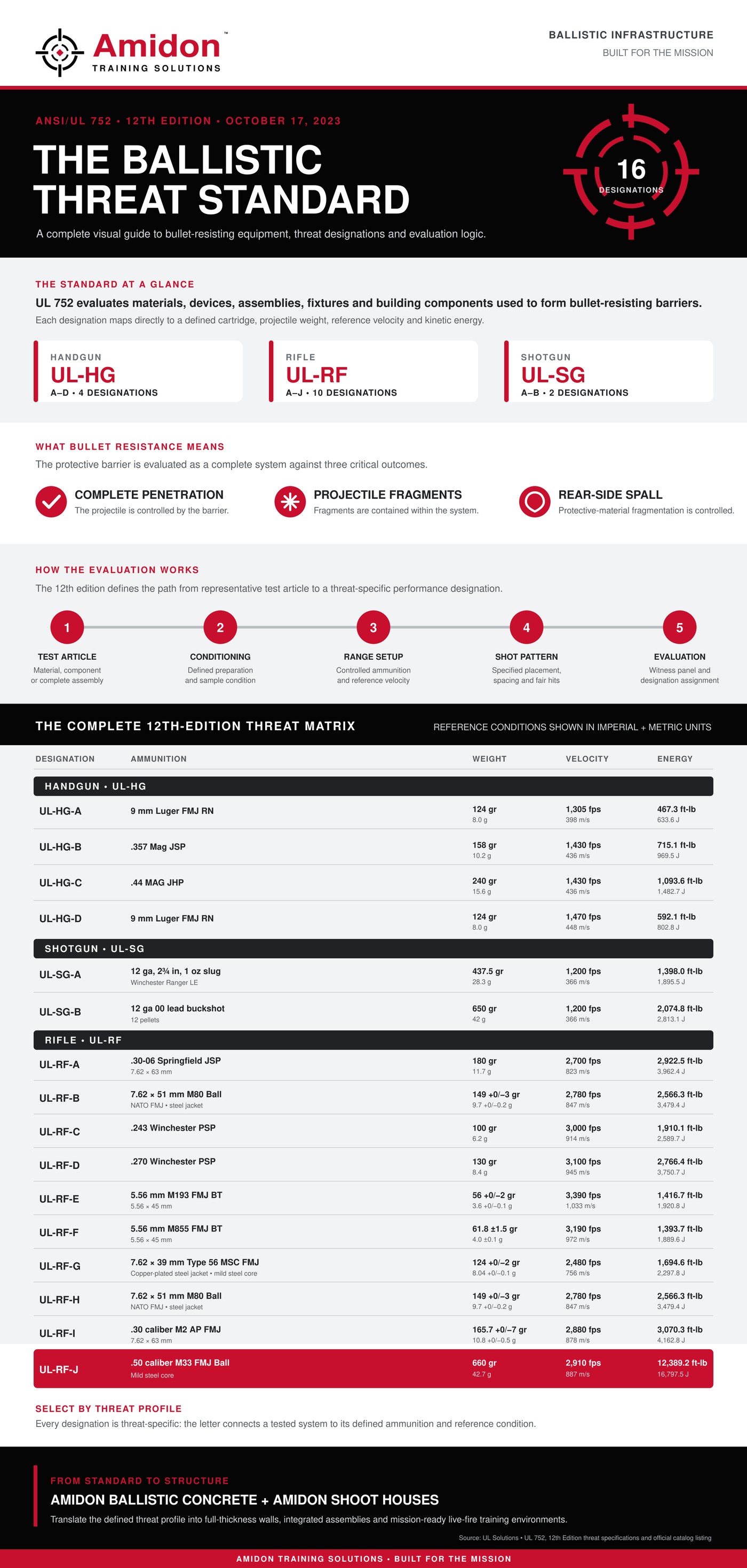
UL 752 is the recognized standard for bullet-resisting equipment. Its scope includes materials, devices, fixtures, assemblies and building components used to create protective barriers, including walls, windows and other integrated systems. The standard evaluates three critical outcomes:
- Complete penetration — the projectile is controlled by the barrier
- Projectile fragments — fragments are contained within the system
- Rear-side spall — protective-material fragmentation is controlled
This system-level view is important. A ballistic barrier must do more than interrupt a projectile’s forward path — it must absorb and control the impact event so that the protected side of the barrier remains secure. That is the same principle behind Amidon Ballistic Concrete. ABC uses the full mass of the wall to absorb energy, capture projectiles and maintain a resilient training surface, so ballistic performance is part of the material and the structure rather than an added surface treatment.
Sixteen Clearly Defined Threat Designations
Published and ANSI-approved on October 17, 2023, the 12th edition organizes its ballistic requirements into 16 threat-specific designations:
- Four handgun designations — UL-HG-A through UL-HG-D
- Ten rifle designations — UL-RF-A through UL-RF-J
- Two shotgun designations — UL-SG-A and UL-SG-B
Each designation connects the tested system to a defined ammunition type, projectile weight, reference velocity and kinetic energy — a practical language for matching ballistic protection to the weapons and ammunition relevant to a facility’s mission. The designations are threat-specific by design, so a facility can be planned around the actual operating requirement rather than a generic description of ballistic strength.
Understanding UL-RF-J
UL-RF-J identifies the .50-caliber M33 full-metal-jacket ball threat with a mild steel core. The published reference condition specifies a 660-grain projectile traveling at 2,910 feet per second, producing approximately 12,389 foot-pounds of kinetic energy — the top of the 12th edition’s rifle matrix.
That profile demonstrates why large-caliber ballistic protection is an infrastructure problem, not simply a material-selection exercise. The barrier must control an extraordinary combination of projectile mass, velocity and impact energy while preserving protection on the occupied side. Amidon approaches that challenge through structural mass, material science and complete-system design: Amidon Ballistic Concrete can be configured into thick, monolithic wall sections that absorb and distribute impact energy throughout the wall body, and the same technology can be incorporated into precast elements, modular construction and purpose-built protective structures.
How the 12th-Edition Evaluation Works
The 12th edition strengthens the connection between the threat designation and the way the test is conducted:
- Test article — the material, component or complete assembly under evaluation
- Conditioning — defined preparation and sample condition
- Range setup — controlled ammunition and reference velocity
- Shot pattern — specified placement, spacing and fair hits
- Evaluation — witness panel review and designation assignment
This disciplined process produces a result that can be used by the people responsible for facility design and procurement. Instead of relying on broad ballistic claims, a project team can establish the relevant threat designation and build the performance requirement into the project from the beginning. That matters in a shoot house because the wall is only one part of the ballistic envelope — doors, windows, wall joints, corners, penetrations, observation points, breaching features and other assemblies all affect how the finished facility performs. The strongest projects carry the threat requirement through every element of the design.
Why the Standard Supports the Amidon Technology Platform
UL 752’s threat-specific structure reinforces the value of Amidon’s integrated approach to ballistic construction:
Amidon Ballistic Concrete
Engineered to capture live ammunition within the wall mass while supporting the structural and operational requirements of a live-fire facility. Its full-thickness performance makes the wall itself the ballistic system.
Amidon Shield
Extends the material platform into multiple construction methods — precast, cast-in-place, tilt-up and filled masonry — so the construction approach can follow the project’s design, schedule and site conditions.
Amidon ArmorBlock
A standardized, modular way to build reinforced ballistic walls. Its open-ended, fillable block architecture works with Amidon Shield to create a continuous protected wall system built through conventional masonry workflows.
Amidon Shoot Houses
Brings the material, structural and training requirements together into a complete live-fire environment — room configurations, streetscapes, breaching locations, target systems and realistic training effects, all built around the mission.
This is where the UL 752 framework becomes especially useful. The selected threat designation becomes an engineering input for the entire structure, helping align wall sections, assemblies and facility details with a clearly defined ballistic requirement.
From Threat Definition to Mission-Ready Infrastructure
UL 752, 12th Edition, creates a clear path from threat identification to tested performance — a common language for comparing systems, writing requirements and defining the ballistic environment a project must address. Amidon turns that defined requirement into infrastructure. Through Ballistic Concrete, Shield, ArmorBlock and complete Shoot House systems, Amidon can match material technology and construction strategy to the needs of the mission. The threat is defined. The response is engineered.
Sources: UL Solutions — What Does It Take to Stop a Speeding Bullet? and UL Standards & Engagement — UL 752, Edition 12.
Related Reading