
Amidon Briefing · Air Assault Training
October 12, 2026
What to Specify in Sling Load Training Blocks
A sling load training block looks like the simplest item on a training equipment list. It is also one that gets lifted, set down hard, dragged, stacked and trucked hundreds of times. What a rotary-wing unit writes into the requirement decides whether those blocks stay in service or end up as unidentified concrete at the edge of a landing zone.
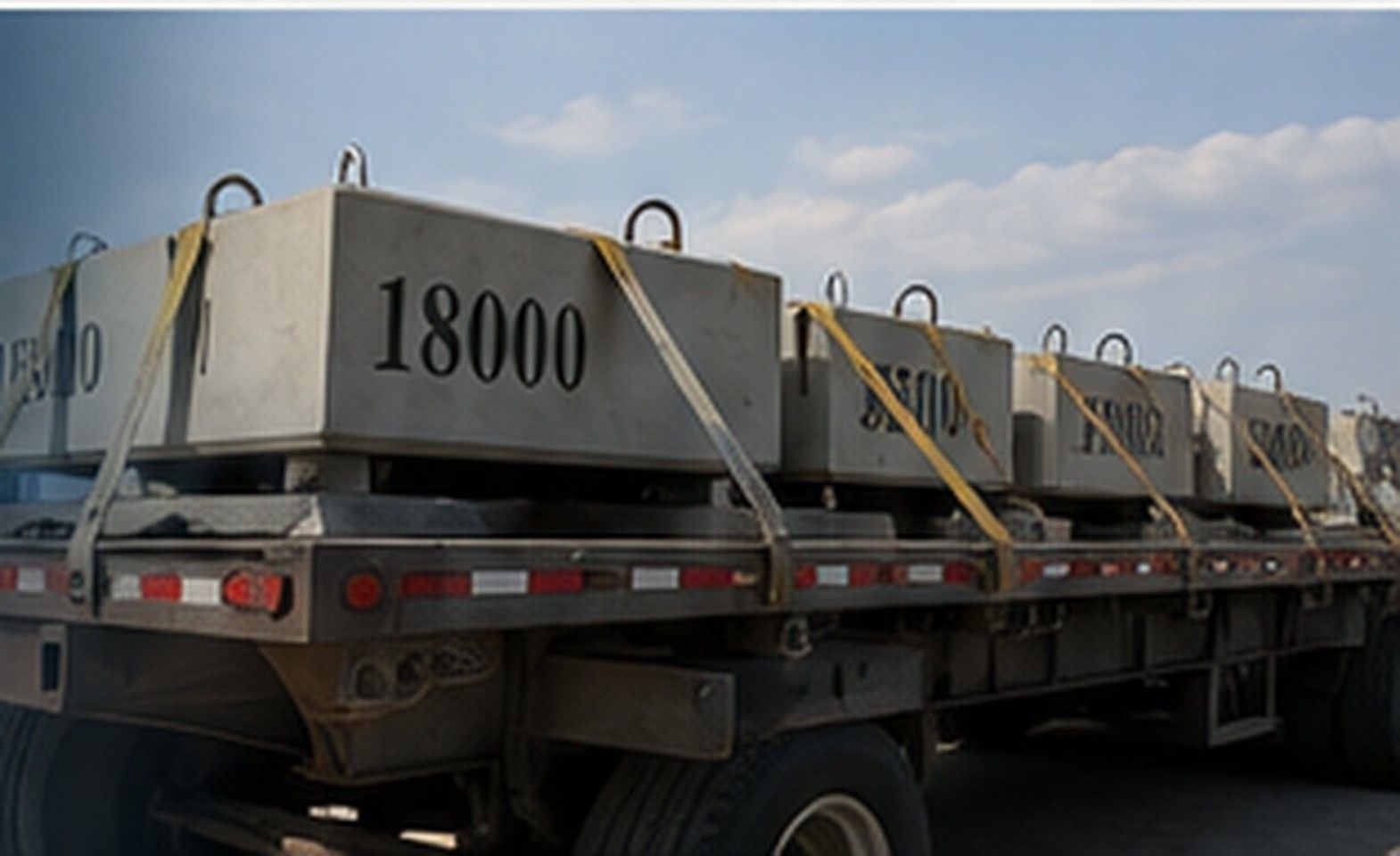
External-load training needs a load that behaves like cargo without being cargo. Using operational equipment as a training load puts vehicles, howitzers and generators at risk every time a hookup goes wrong. A purpose-built training block removes that risk, but only if it is specified as a piece of lifting equipment rather than a slab of concrete. The requirement should describe weight, rigging, durability, identification and logistics, because each of them fails in a predictable way when it is left out.
Specify Weights Against the Training Tasks
Start from the loads the unit actually trains to, not from a round number. Amidon builds a standard family of six weights: 1,500, 6,000, 8,500, 12,000, 18,000 and 22,000 lb, mapped to uses from general cargo and light equipment up to large-equipment and heavy-lift training. A unit that trains crews against light tactical vehicles and towed artillery needs different blocks from one that trains heavy-lift aircraft. State the weights and the quantity of each, and state how the delivered weight is to be identified on the block, because a training load is only useful if the crew can trust the number on it.
Specify the Rigging Points, and How They Are Tested
The lifting provisions are the part of the block that carries the aircraft’s load. They should be cast into the block and tied into its reinforcement, not attached to the surface afterward. Specify lift points that suit the sling sets the unit uses, and require proof-load testing of each block with its lifting provisions in place. Amidon Sling Blocks use embedded steel pipes and lift eyes, and each block is individually proof-load tested in accordance with MIL-STD-913. As an example of how the result is expressed, the 12,000 lb block is proof tested at 38,400 lb, a load factor of 3.2. Proof-test values verify the block and its embedded lifting provisions at that test load. They do not supersede aircraft, cargo hook, sling-set, rigging, inspection or mission-planning limits, and the requirement should say so.
Why Concrete Training Loads Wear Out
Concrete is a sensible material for a training load: dense, easy to shape and indifferent to weather. It also wears in recognizable ways. Corners and edges chip when a block is set down hard or skids across gravel. Cracks start where loads concentrate, often around lifting hardware. Painted weight markings fade within a few seasons of sun. And once a corner breaks away or a lift point is damaged, two things are lost at once: confidence in the weight and confidence in the rigging. A block in that condition has to come out of service, and a unit that bought the least expensive loads available can find its inventory shrinking faster than its training calendar allows.
Specify Durability for Repeated Lifts and Drops
Durability language should describe the life the block will actually lead. Require reinforced concrete with rebar, so that a crack does not become a separation. Require lifting provisions that are part of the block’s structure. Describe the handling the blocks will see: repeated hookups and set-downs on unprepared ground, transport by flatbed, and movement by forklift or crane between training areas. Ask the supplier to state the inspection criteria for removing a block from service, and to support replacement or supplemental blocks in the same weights so the inventory can be kept whole as individual blocks retire.
Specify Marking a Crew Can Read
In the field, identification has to work at a distance, from any side, in low light and after years of weathering. Amidon Sling Blocks carry cast-in weight markings on all sides and the top, integral concrete dye for color coding, a brass identification plate with weight, manufacturer, date and serial number, and recessed reflectors for low-light operations. Whatever the source, the requirement should ask for markings that are part of the block rather than applied to it, and for a serial number on every block. Serialization turns a pile of concrete into a tracked asset: each block can carry its own proof-test record and inspection history.
Plan Delivery and Handling Before Award
Training blocks are heavy freight, and the logistics deserve the same attention as the blocks. Confirm the delivery location and the route to it, including gate procedures and access for flatbed trucks. Confirm that the receiving unit has offload equipment with capacity for the heaviest block, and a staging area with firm, level ground near the landing zone. When requesting a quote, send the required weights, quantities, delivery location, required-by date and any technical documents that govern the purchase. With that information, Amidon can respond with a configuration, production schedule, logistics requirements and the technical package needed to move the purchase forward.
A sling load training block is lifting equipment that happens to be made of concrete. Specify it that way: known weights, tested lifting provisions, construction that survives repeated handling, identification that lasts, and a delivery plan that gets every block to the landing zone ready for the first lift.
Related Reading