
Amidon Briefing · Training Facilities & Range Components
The Fastest Path to Subterranean Readiness May Already Be on the Range
Across the Department of Defense, existing shoot houses represent years of investment in land, ballistic construction, access roads, utilities and range infrastructure. Many of these facilities remain structurally useful, but the mission has moved beyond the room-clearing scenarios for which they were originally designed. That does not make the facilities obsolete. It makes them an opportunity.
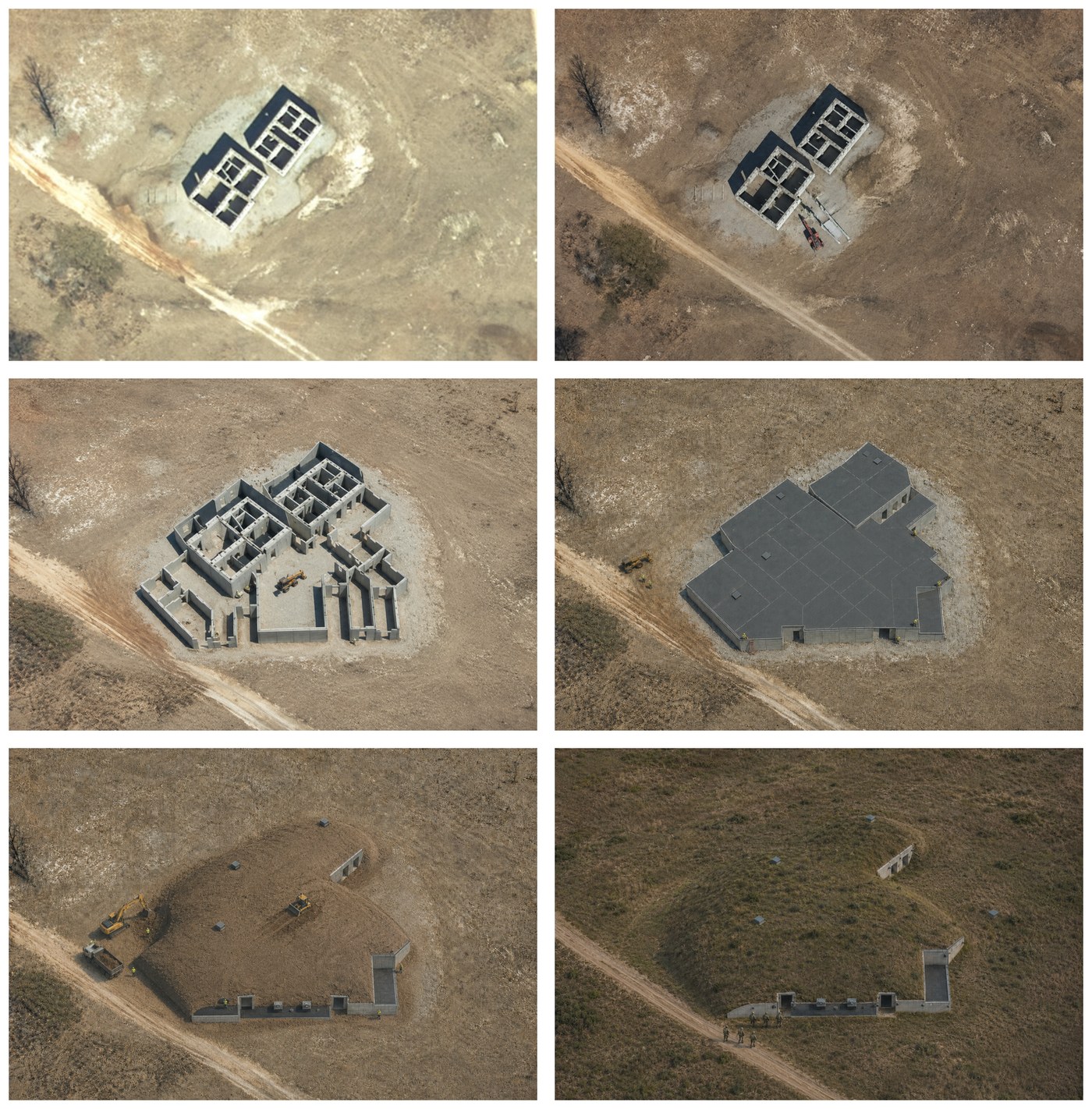
Instead of abandoning a serviceable shoot house and starting over somewhere else, the military should consider using it as the foundation of a covered, connected subterranean training complex. Existing structures can become the anchor points for new tunnels, enclosed passages, utility spaces, command-and-control areas and specialized training routes. Roof systems and environmental controls can transform an exposed facility into a realistic, all-weather environment. Earth cover can then be added when terrain integration, thermal signature, concealment or mission requirements justify it. The result is not simply a renovated shoot house — it is a new training capability built around infrastructure the government already owns.
The Warfighter Mission Has Changed
The contemporary operating environment is increasingly urban, connected and contested in every domain. Recent conflicts have shown how subterranean networks can support maneuver, logistics, command and control, weapons storage, ambushes, protected movement and the reentry of forces into areas thought to have been cleared.
The Army’s own analysis now treats subterranean operations as a central large-scale combat operations challenge. The Center for Army Lessons Learned has identified urbanization and the proliferation of uncrewed aerial systems as major drivers pushing forces underground. Its 2025 subterranean operations report calls for units to train above and below ground simultaneously and to practice with air monitors, breathing equipment, uncrewed ground vehicles, breaching tools, ballistic shields and specialized casualty-evacuation equipment.
This is a combined-arms and multi-domain problem. Infantry must clear and control confined spaces. Engineers must assess, breach, bypass or neutralize underground systems. Military working dogs and robotic systems must move through passages that may be inaccessible or too hazardous for immediate human entry. Medics and aid-and-litter teams must move casualties around obstacles, through narrow corridors and up vertical access points. Leaders must maintain a common operating picture while communications, positioning and visibility are degraded. Those tasks cannot be mastered in a conventional open-air shoot house alone.
Subterranean Training Does Not Have to Start Below Grade
One of the most important lessons for installation planners is that a credible subterranean training environment does not require excavating an entirely new underground facility. The Army’s subterranean training complex at Fort Bragg establishes the precedent. The Center for Army Lessons Learned describes that facility as being built mostly above ground while providing more than a kilometer of tunnels of varying sizes and dimensions. What gives the facility its value is the operational environment it creates: restricted movement, limited visibility, complex routing, controlled access, unfamiliar geometry and the need to coordinate forces above and below the surface.
That same logic can be applied to existing shoot houses across the force. An installation can retain the current ballistic structures, connect them with full-height passageways, add enclosed rooms and specialized routes, install a precast roof system and waterproof membrane, and then use grading or imported fill to create the desired terrain profile. Where earth cover is unnecessary, the roofed complex can remain accessible for maintenance, reconfiguration and future expansion while still reproducing the enclosed conditions required for subterranean training.
This approach shifts the question from “Where can we build a new underground facility?” to “How can we turn what we already own into the capability the warfighter now needs?”
What a Shoot-House Conversion Can Add
A covered conversion can expand a conventional facility into a much broader training system:
Connected tactical routes
Existing shoot houses can be linked through new ballistic passages, intersections, dead ends, doglegs and branching routes that force units to transition between buildings, tunnels, rooms and surface access points while maintaining security in multiple directions.
Simultaneous above- and below-ground operations
The complex can support one element operating within the enclosed network while another secures portals, controls the surface or responds to an adversary emerging elsewhere — directly supporting the Army’s requirement to coordinate subterranean and surface elements.
Military working dog and robotic access
Low-profile culverts and dedicated bypass routes can be incorporated for military working dogs, sensors and uncrewed ground systems, allowing units to practice reconnaissance and exploitation before committing personnel to an uncertain space.
Breaching, EOD and engineering tasks
Purpose-built breach points, portals and sacrificial components can support mechanical, ballistic and explosive entry training, so engineers and EOD personnel train as part of the maneuver force rather than in a separate facility.
Casualty movement and confined-space problem solving
Narrow routes, turns, level changes and controlled obstacles create realistic conditions for casualty evacuation, equipment movement and team communication — the physical problems that determine whether a unit can maintain momentum underground.
Live-fire and non-lethal training
The same complex can support live-fire training within designated ballistic areas and non-lethal training ammunition for force-on-force exercises, serving both weapons proficiency and decision-making scenarios.
A Covered Facility Becomes a Technology Platform
Enclosing the complex makes it possible to control the environment in ways that an open-air shoot house cannot. Ventilation systems can move high volumes of air, support smoke clearance and create controlled airflow between training areas. Programmable lighting can reproduce total darkness, emergency illumination, intermittent power and disorienting transitions. Sound, scent and smoke systems can create realistic atmospheric cues. Cameras, shot detection, position tracking and other sensors can capture the exercise for immediate after-action review.
A protected service spine and equipment core can keep power distribution, fiber, data networks, controls, patching, ventilation equipment and other critical systems accessible to staff while remaining separated from likely lines of fire. Range operations and after-action-review spaces can then receive synchronized video, audio and sensor data without placing instructors or technicians inside the live-fire envelope.
The facility can also be used to create deliberately degraded conditions. Units can train through limited radio coverage, intermittent network access, GPS denial, reduced visibility and conflicting sensor information — turning a physical structure into a multi-domain training environment where communications, electronic warfare, unmanned systems and tactical decision-making are exercised together.
The Value Proposition Is More Than Lower Construction Cost
Reusing existing shoot houses protects the value of infrastructure the military has already purchased. The current walls, foundations, access routes, range location and supporting assets become the first phase of the new facility rather than demolition waste or stranded capital. The approach can also shorten the distance between requirement and training capability — a conversion begins with a known site and a standing facility, so the project team can focus its resources on the mission gap: connections, roofs, utilities, effects, control systems and specialized training features.
Just as importantly, the work can be phased:
- Assess and plan. Survey the existing structures, define the training requirement and establish the new circulation, safety and access concept.
- Connect and expand. Add ballistic passages, rooms, storage, utility spaces, K9 routes and emergency egress.
- Enclose the complex. Install roof panels, drainage and a continuous waterproofing system.
- Integrate training technology. Add ventilation, power, data, lighting, cameras, sensors, atmospheric effects and after-action-review capabilities.
- Shape the terrain. Add earth cover or berming where the mission, site and future expansion plan call for it.
This phased model allows an installation to build capability as funding becomes available while preserving the option to expand or reconfigure the complex later. It also makes the project easier to align with unit priorities because every phase produces a useful improvement rather than waiting for a single greenfield program to deliver the entire capability.
Amidon Was Built for This Type of Conversion
An Amidon conversion begins with the infrastructure already in place and retains every serviceable element that can contribute to the new mission. Where the existing facility was built with Amidon Ballistic Concrete, its modular wall system is inherently suited to adaptation: walls can be opened, extended, connected and repaired while existing rooms remain in service. New full-height passages and training spaces can then be added using the same ballistic construction approach.
Amidon can then integrate precast roof systems, protected equipment cores, clean service corridors, emergency egress, low-profile K9 routes and range-operations connectivity around the existing structure. The conversion can support live fire, non-lethal ammunition, immersive effects and sensor-driven after-action review within one coordinated facility.
The strategic point is straightforward: a shoot house that no longer matches the mission may still be the most valuable starting point on the range. The military does not need to choose between accepting an outdated training environment and replacing the entire facility. It can preserve the investment already in place, add the capabilities demanded by current doctrine and create a covered subterranean complex that can continue evolving with the warfighter mission. The infrastructure already exists. The next mission can be built from it.
Sources: U.S. Army — Urban Combat and the Gaza Metro, Center for Army Lessons Learned — Subterranean Operations: Lessons from Gaza, and U.S. Army — Underground Soldiers.
Related Reading